




Canada spent the first half of September answering Washington’s trade escalation dollar for dollar after the United States imposed 50% tariffs on a broad range of Canadian goods that extend well beyond the stated grievances of autos, dairy and alcohol.
Canada’s counter-tariffs on C$27.6 billion ($19.7 billion) of US imports took effect September 8 and this week the same government hosted the first Canada Investment Summit in Toronto, putting a 167-project prospectus in front of investors managing a suspiciously rounded C$100 trillion.
American managed money, rather uncomfortably, accounted for the bulk even with the world’s richest sovereign wealth funds in the same room. Ottawa has been tight-lipped, but leaked reports count about $360 billion in pledges. Mining is the largest category by number with 63 entries, but cheap at the price at a little over $53 billion required.
Mining is dwarfed by mega projects like the $57 billion expansion of the ice-free-for-four-months-of-the-year Port of Churchill, a $44 billion offshore wind farm off Nova Scotia to slow global warming (something those advocating for Churchill may want to work into their base case), and a $25 billion oil pipeline to the Pacific that would have to succeed where Northern Gateway did not.
Sitting on gold mines
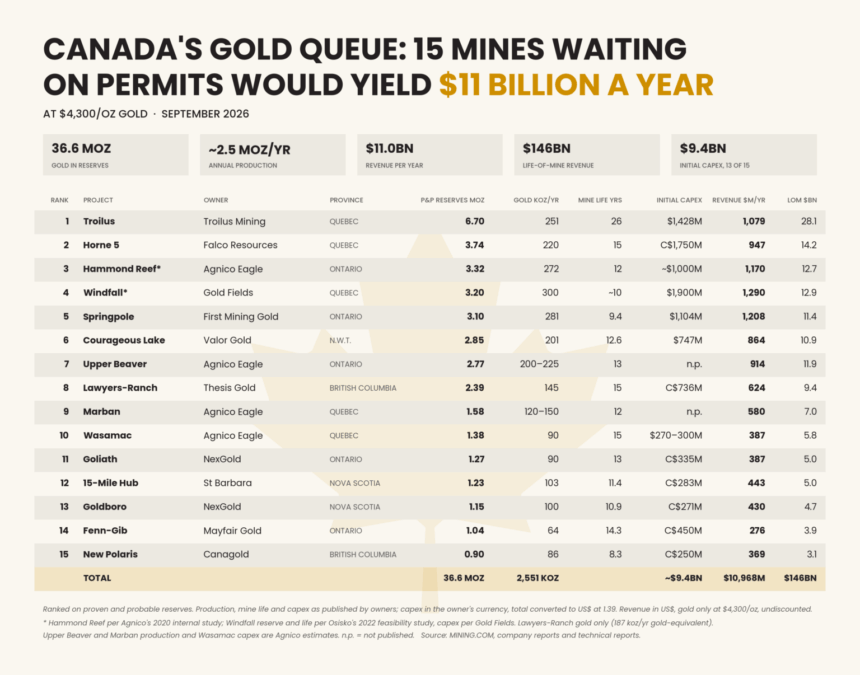
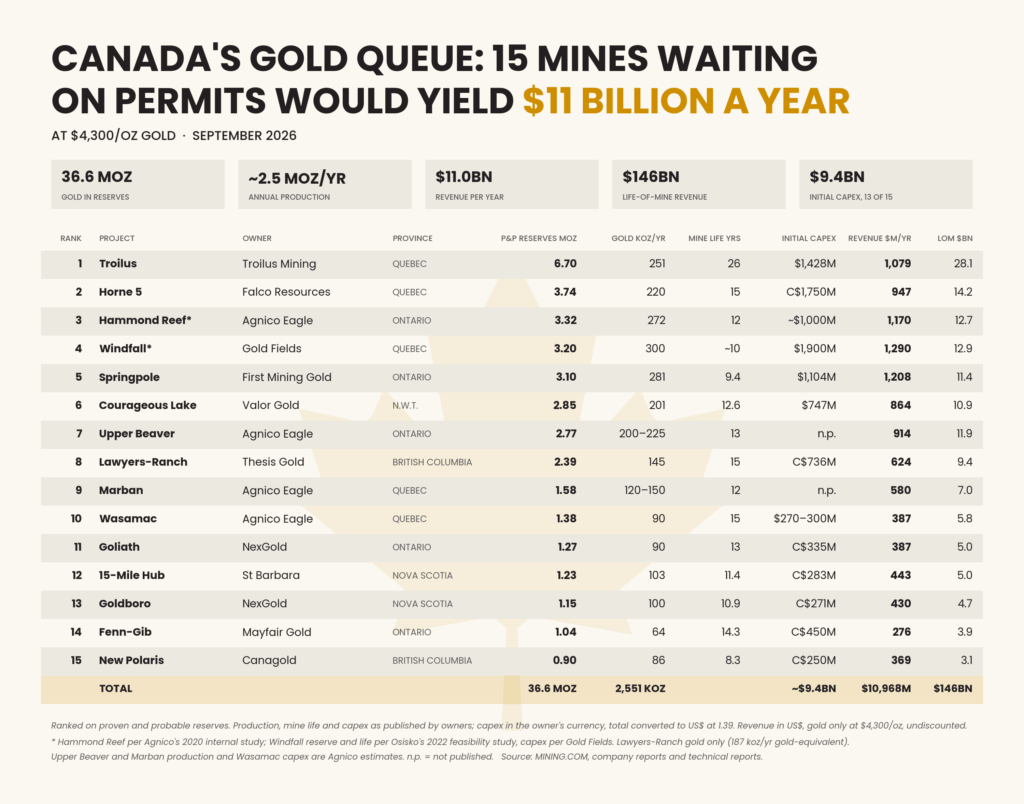
Three gold projects have confirmed they are in the book: Troilus in Quebec, NexGold’s fully permitted Goldboro in Nova Scotia, and Canagold’s New Polaris in British Columbia. They belong to an entirely different category from the tentpole projects. These, and a dozen other Canadian gold projects we looked at, have mine plans and declared reserves, the capital required is barely in double-digit billions, the studies are done, and in five cases the only thing between the owner and a construction decision is one government signature.
At today’s gold price they would produce a shade under $11 billion a year in revenue on an initial capital bill of $9.4 billion from thirteen published numbers (and another billion-odd estimated for the remaining two).
That’s enough to buy almost 50 medium ice-breaker escorts, hook up a third of the nacelles (depending on prices for rare earth, which Canada is still attempting to mine) needed for phase one of Wind West and a decade’s worth of ESG red tape and lawsuits for the pipeline.
Gold is the one major Canadian export for which the American market is optional. Bullion enters the US duty-free, and that status was even reaffirmed by a Trump executive order last September when Swiss kilobars were slapped with a 39% duty after a customs cock-up.
In any case, it does not need the American market: doré poured in Canada is refined and sold into London and Zurich at the same price on the same day.
At roughly $4,300 an ounce, Canada’s 213 tonnes of 2025 mined output ranked fourth in the world and was worth close to $30 billion. The question this piece asks: is how much more is sitting in the permitting queue, and how quickly it could fill Canadian coffers.
We screened Canada’s gold development projects for three things: a prefeasibility or feasibility-level mine plan, which under CIM rules is the minimum for declaring a mineral reserve; a meaningful reserve; and no construction decision taken.
That last test drops some of the country’s most talked-about projects. Kinross’ Great Bear was fast-tracked by Ontario in February but is still at PEA stage with no reserves. Agnico Eagle greenlit the $2.4 billion Hope Bay mine in May. Osisko Gold Group took the construction decision on Cariboo on September 14, the morning the summit opened. Fuerte’s Coffee project in Yukon is building its access road ahead of a feasibility study due in the fourth quarter.
Fifteen projects survive, ranked on contained gold in proven and probable reserves (a measure of scale, not value): New Polaris at the bottom of the list grades 9.94 g/t, Hammond Reef near the top grades 0.84 g/t).
Together they hold 36.6 million ounces of reserves. Using the owners’ published production profiles, or their own internal estimates where no study exists, they would produce around 2.5 million ounces a year at steady state, roughly 78 tonnes, or a 35–40% increase on Canada’s current output. At $4,300, that’s $146 billion over the mine lives.
Crown achievement
For a country counting tariff losses, quick wins before the trade winds change direction again should be a no-brainer. Gold mines are unusually good taxpayers. On top of the 26.5% corporate rate every other industry pays, a mine pays a provincial mining tax or duty on profit first, taking the combined government share of its operating margin to roughly 34% in Ontario, 37% in BC and the Northwest Territories, 40% in Nova Scotia and 42% in Quebec.
Using an industry-average cost of $1,800 an ounce and $4,300 gold, the 15 projects would send on the order of $2.4 billion a year to federal and provincial treasuries, and something like $33 billion over their lives, about half of it to Quebec. Those are mature-year figures as a new mine writes off its construction capital before paying meaningful income tax, so the early years yield far less. All the more reason to start blasting sooner rather than later.
The $2.4 billion is also a good chunk of what Finance Canada could raise from counter-tariffs, or put another way, how much more Canadians have to fork out for the same things they wanted up until September 7. Those who are doing their patriotic duty by forgoing Jack and coke want to know.
The best laid plans
First gold pour at these projects cluster at the end of the decade: Windfall in 2029 if its Quebec approval lands this year, Troilus, Springpole, Upper Beaver and Fenn-Gib around 2030, Goldboro as early as 2028, Marban and Wasamac in 2033-34. Almost all of those are management targets (or if we must import corporate speak from softer industries: “aspirational”) rather than study schedules.
The construction periods behind them are short, one to three years, but in Canada’s permitting hell that hardly matters. S&P Global’s survey of mines that started up between 2020 and 2023 found they took an average of 17.9 years from discovery to first production, five years longer than a decade earlier, with almost all of the stretching out coming from permitting and the wait between feasibility study and construction. Gold mines were the fastest, at only 15 years (yes, only).
Canada, on S&P’s small sample, was among the slowest countries in the world at 27. Not to put too fine a point on it, but that’s hitting pay dirt under Jean Chrétien and still waiting to be paid for dirt under Mark Carney.
PwC’s Mine 2026 report puts the Canadian figure at about 20 years to permit and build, six more than Australia. Australia’s blanket tariffs are capped at 12.5% and Albanese decided against counter tariffs. Same insult, less injury.
Waiting room
Several projects on this list are already deep into that two-decade clock.
Gold Fields’ Windfall has a Cree agreement, 12 km of underground and a $1.9 billion budget, and has been waiting since the first quarter for a COMEX decision. Falco’s Horne 5 has a three-month-old feasibility study and Glencore’s smelter next door and is waiting on a Quebec decree. First Mining’s Springpole cleared its federal review in June, eight years after it began, and is now waiting on Ontario.
Agnico Eagle‘s Hammond Reef has both federal and provincial environmental approvals and, on Agnico’s own 2020 numbers, would produce a glittering 272,000 ounces a year; the company says it is not approved for development. Upper Beaver, Marban and Wasamac are on a schedule that runs to 2033.
How much of that is Agnico’s own sequencing and how much is its read on how long the remaining permits will take is Agnico’s to say. What the numbers say is that a single company holds a quarter of the queue, and that its earliest-permitted project is the one with no date attached.
Dead in the water
Our 15 projects may well prosper soon, but examples of Canadian permit peril and regulatory ruin are not hard to find.
Take Taseko Mines’ Prosperity copper-gold deposit at Fish Lake, one of the largest undeveloped in the country. It received British Columbia’s environmental certificate in January 2010. Ottawa rejected it that November over the plan to use a lake called FISH lake for tailings (sounds bad, sure, but Taseko was going to build a new lake with all 85,000 rainbow trout relocated).
Taseko redesigned it, resubmitted it as New Prosperity, and was rejected again in February 2014. Four months later the Tŝilhqot’in Nation won the Supreme Court title case that reset the ground rules for the whole region.
A decade of litigation followed, ending in June 2025. Taseko gave up and BC forked over C$75 million. Sixteen years after the provincial approval, the deposit is still in the ground and nobody is proposing to do anything in the area other than fly fishing.
Don’t bother
NexGold’s Goldboro, which just yesterday said hoes and dozers are now on site, is the exception that proves the rule. Fully permitted, with a Crown lease and a Mi’kmaq benefits agreement, it is waiting on financing rather than a signature. It is easy to blame permitting (guilty as charged) for the inertia in Canada’s mining industry, but TSX Venture juniors still have to raise the capital.
The Productivity Mega Deduction (a name which veers into Big Beautiful Bill territory at a time Canada is trying to distance itself from bluster from the south) will help build mines, but the ambitions of the summit’s marquee vehicle, the C$50 billion Maple Fund launched by CPP Investments and Brookfield, are too lofty for the grassroots.
The fund is looking for opportunities with more than C$5 billion of project equity. Not one of the fifteen gold projects clears that bar and six of them need less than C$500 million each: the kind of cheque that the MF cannot be bothered to write.
Even the most expensive gold mine ever built in the country, Iamgold and Sumitomo’s Côté in Ontario, came in at a billion below. And that was after a C$2.3 billion budget blowout.
The rest of the list is earlier. Thesis Gold’s Lawyers-Ranch, Mayfair’s Fenn-Gib, St Barbara’s 15-Mile hub and Canagold’s New Polaris all entered environmental review in the past year. Valor’s Courageous Lake has not applied.
Queue the fast track
Canada has four: the federal Major Projects Office, Ontario’s One Project One Process, Quebec’s new Filon stream and BC’s priority list. Two of the 15 are in one, Troilus and New Polaris. The other thirteen, including Windfall, Horne 5, Hammond Reef and Springpole, are on the standard track.
Carney told reporters after the summit that the standard would now be “one project, one review, one year.” But much like those pesky interprovincial barriers Carney says cost “up to $200 billion” a year and promised to sweep away with “one Canadian economy, not thirteen,” and which the provinces have yet to dislodge no matter how loudly Trump’s tariffs are derided from podiums, it is often in the provinces that the fast track goes off the rails.
Provinces control much of the review, and the 15 show where the test lies: Quebec holds the decisions on Windfall and Horne 5, Ontario on Springpole, and Agnico’s four sit in both. The projects are known, studied and in several cases already approved by one level of government.
Everything on the table is at $4,300. The banks think that is low. J.P. Morgan’s research desk has gold averaging $5,400 by the end of 2027 and calls $6,000 a realistic longer-term target; Wells Fargo has $5,800 to $6,000 by the end of 2027. Goldman Sachs, after trimming, still has $4,900 for year-end.
Ottawa, you can do the math.
Source: https://www.mining.com/gold-is-tariff-proof-canada-has-11-billion-a-year-of-it-stuck-in-permitting/