




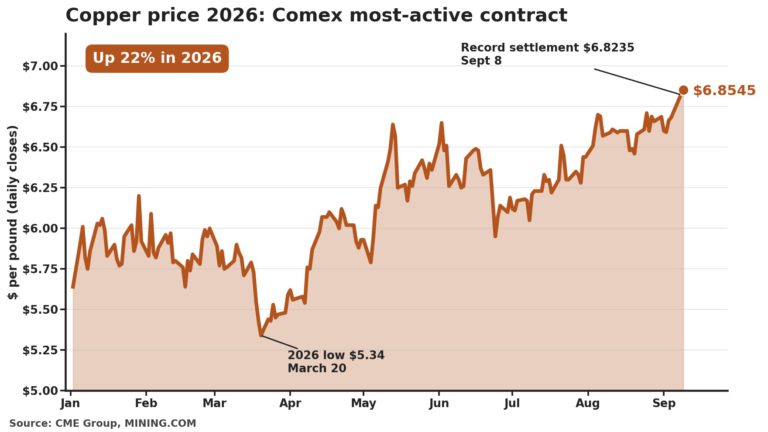
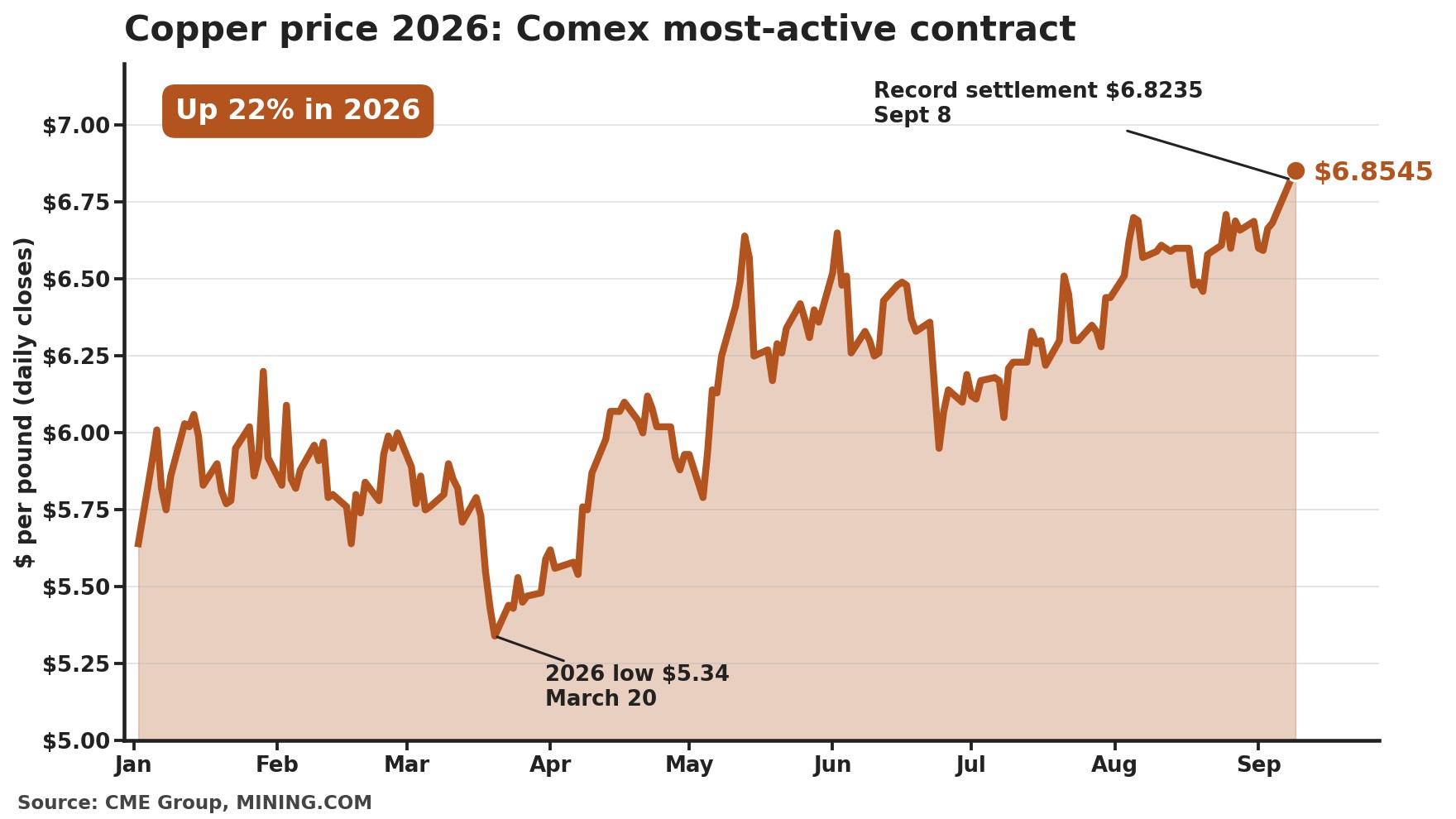
Copper paused just below record territory on Wednesday after four straight sessions of gains carried the metal to all-time highs in New York and London, with the escalating conflict in the Middle East pushing Brent crude back above $100 a barrel and reviving worries about inflation ahead of Friday’s US consumer price data.
Comex copper for December delivery, the most active contract, was up 0.5% at $6.8545 a pound (about $15,110 a tonne) by late morning in New York, after touching $6.8730 on Tuesday, the highest ever for a Comex contract and above the $6.7775 peak the September contract set on August 26. Tuesday’s settlement of $6.8235 was also a record.
In London, three-month copper slipped 0.4% to $14,645.50 a tonne by late morning after climbing to an all-time high of $14,779 on Tuesday and closing at $14,708, the second record in as many days after Monday’s push past the January peak of $14,527.50. The LME’s index of six base metals also set a record on Tuesday as zinc breached $4,000 a tonne for the first time since 2022. Aluminium, nickel and lead all eased on Wednesday.
Draining into the US
China imported 382,000 tonnes of unwrought copper and copper products in August, down from 425,000 tonnes in July and the weakest August in six years, customs data show, taking the January to August total to 3.3 million tonnes, 6.7% below last year. The metal is going west instead. US imports of refined copper hit a record 225,094 tonnes in July, with Chile supplying 46% and a record 53,290 tonnes arriving from the Democratic Republic of Congo, even though no Congolese brand is deliverable against the Comex contract.
Traders have spent the year moving copper into the US ahead of a 15% duty on refined imports proposed for January 2027, rising to 30% in 2028, which Washington has neither confirmed nor ruled out more than two months after the Commerce Department was due to report. Comex warehouses held a record 695,624 tonnes on Friday, more than double the roughly 300,000 tonnes left in LME and Shanghai sheds combined. Shanghai’s 63,000 tonnes is the lowest since January 2024, and LME stocks have shed nearly 40% since late May.
Total exchange stocks of 993,276 tonnes are up 33% this year, according to John Gross’s The Copper Journal, but the split has inverted: Comex holdings have grown 53% in 2026 while Shanghai’s have fallen 57%. “There’s plenty of physical copper in the world, but it’s all in the United States,” SP Angel’s John Meyer told Reuters on Tuesday, adding that copper should keep rising as long as there is no clarity on tariffs.
Leaching pays again
High prices are pulling marginal metal back into production. Collahuasi, the Anglo American-Glencore joint venture in northern Chile, is restarting its mothballed SX-EW plant with a target of 6,000 tonnes of cathode next year, SP Angel said in a note on Wednesday, and Capstone Copper is ramping oxide leaching back up at Mantoverde. Solvent extraction-electrowinning turns leached ore straight into cathode on site and skips the smelter, but it consumes large volumes of sulphuric acid, which has been expensive since the Middle East war pushed Gulf prices from $155 a tonne to $400 and Chinese shipments to Chile dried up. Copper’s 45% rise over the past year covers that bill, the broker said.
Those tonnes are needed. World mine production fell 1.1% in the first half of 2026, the International Copper Study Group said last month, with a 2.6% drop in concentrate output outweighing a 4.3% rise in SX-EW cathode as Chile fell 6.6%, Indonesian concentrate output dropped 32% with Grasberg still constrained and the DRC’s concentrate production fell 34% because of the seismic damage at Kamoa-Kakula. The ICSG’s April forecast, which still assumed 1.6% mine growth for the year, projected a 96,000-tonne refined surplus for 2026.
Morgan Stanley, which entered the year expecting mine supply to grow, now sees it flat to slightly lower, which would make 2026 the first year of falling mine output since 2017. Analyst Amy Gower said the industry is only now feeling the effect of the investment cuts that followed the commodity downturn a decade ago, leaving a thin project pipeline, and that with permitting timelines as they are, new mines are unlikely to add much before 2030. “It’s declining grades at existing operations,” BlackRock’s Evy Hambro told Bloomberg Television last month. “It’s tired, very, very old assets. It’s a lack of new development of supply coming into the market.”
CRU has already written off the 639,000-tonne surplus it projected for the year, telling Reuters last month that continued US imports would make it “a deficit market in reality.” Chile’s copper exports fell to $4.62 billion in August, the lowest since July 2025, after winter storms disrupted mines and ports in a month when prices averaged 40% more than a year earlier.
Testing $15,000
Panmure Liberum’s Tom Price said $15,000 was possible this week on “Trump’s tariff confusion” and the speculative capital behind the trade. Sucden Financial sees scope for further gains while copper holds above $14,400 but warned of profit-taking if the dollar recovers after Friday’s CPI print. Morgan Stanley’s Amy Gower said her fourth-quarter forecast of $14,250 could be overshot depending on how and when any tariff decision lands, though the bank is more cautious on 2027, when US import demand should soften whether tariffs are imposed or ruled out.
Citigroup’s Tom Mulqueen forecasts $15,000 by year-end with a path to about $17,000 if manufacturing, data centre or stockpiling demand surprises, and JPMorgan analysts wrote on Tuesday that copper “still has more left in the tank,” targeting $14,800 in the fourth quarter with “overshoot potential” as China enters its peak demand season. Bloomberg Intelligence’s Mike McGlone offered the counterview in the same report: hedge funds are heavily long and copper’s correlation with the S&P 500 is at multidecade highs, which makes the metal “an accident waiting to happen.”
Ivanhoe extends its run
Copper producers gave back some of Tuesday’s gains. Teck Resources fell 2.6% in New York by late morning, Anglo American 1.9% and Lundin Mining 1.7%, while Freeport-McMoRan, First Quantum and Southern Copper were down fractionally and BHP and Glencore flat. Ivanhoe Mines added another 1.7% after Tuesday’s 12.9% jump on a 30% increase in its Makoko discovery in the DRC to about 12 million tonnes of contained copper, taking its gain over the past week to 17%.
Marimaca Copper, which reported thick copper-silver intercepts at Pampa Medina in Chile on Tuesday, has bought a second-hand acid plant to shield its $587 million oxide project from the same acid market Collahuasi is now wading back into. Anglo American, meanwhile, faces formal EU objections to MMG’s purchase of its Brazilian nickel business, part of the portfolio clean-out that preceded its merger with Teck, with a charge sheet from Brussels expected later this month.
Comex copper is up about 22% in 2026 and roughly 50% over the past year. The August rally added $357 billion to the value of the world’s 50 biggest miners, the largest monthly gain on record.
(With files from Reuters and Bloomberg)