




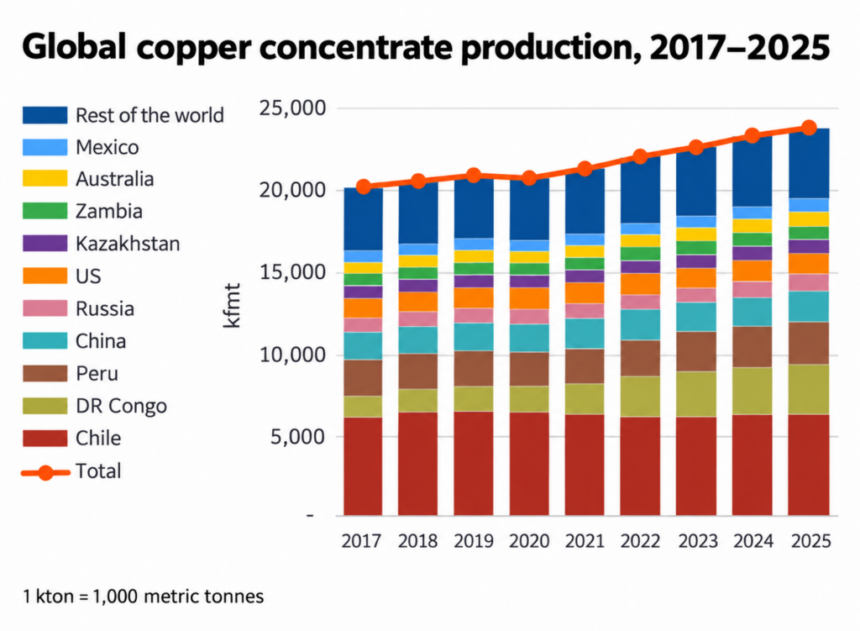
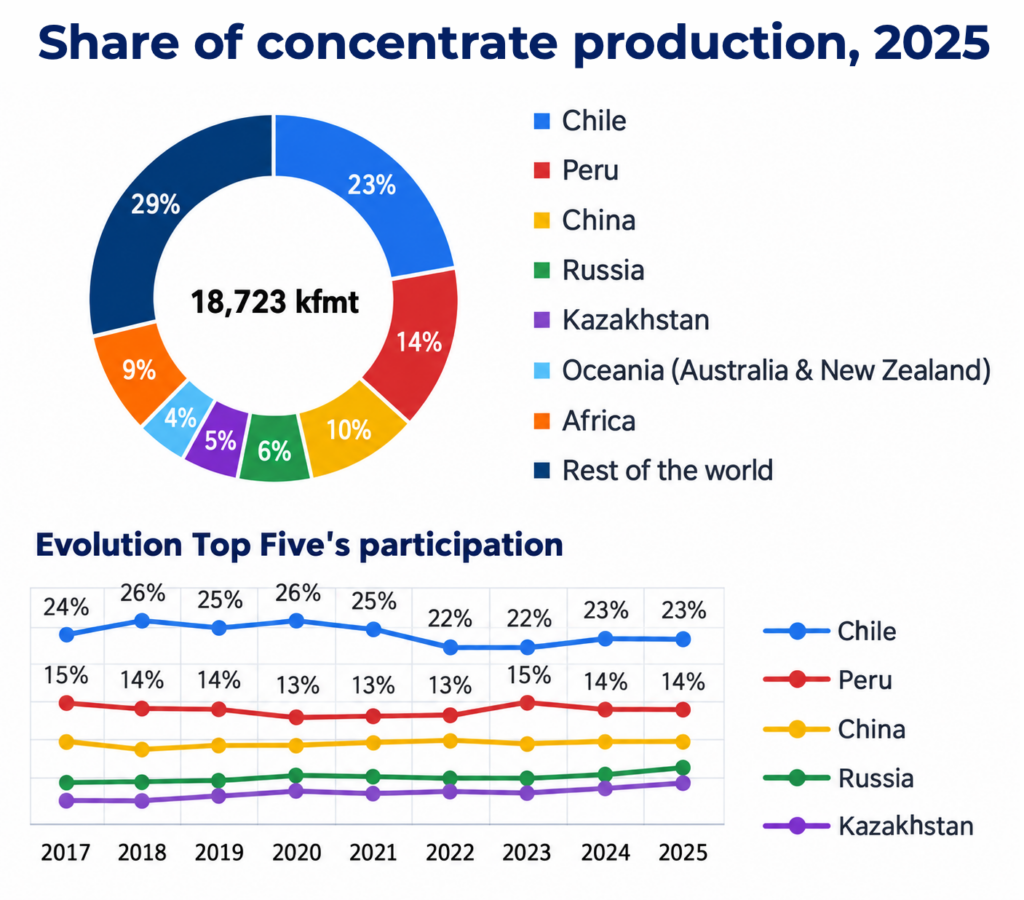
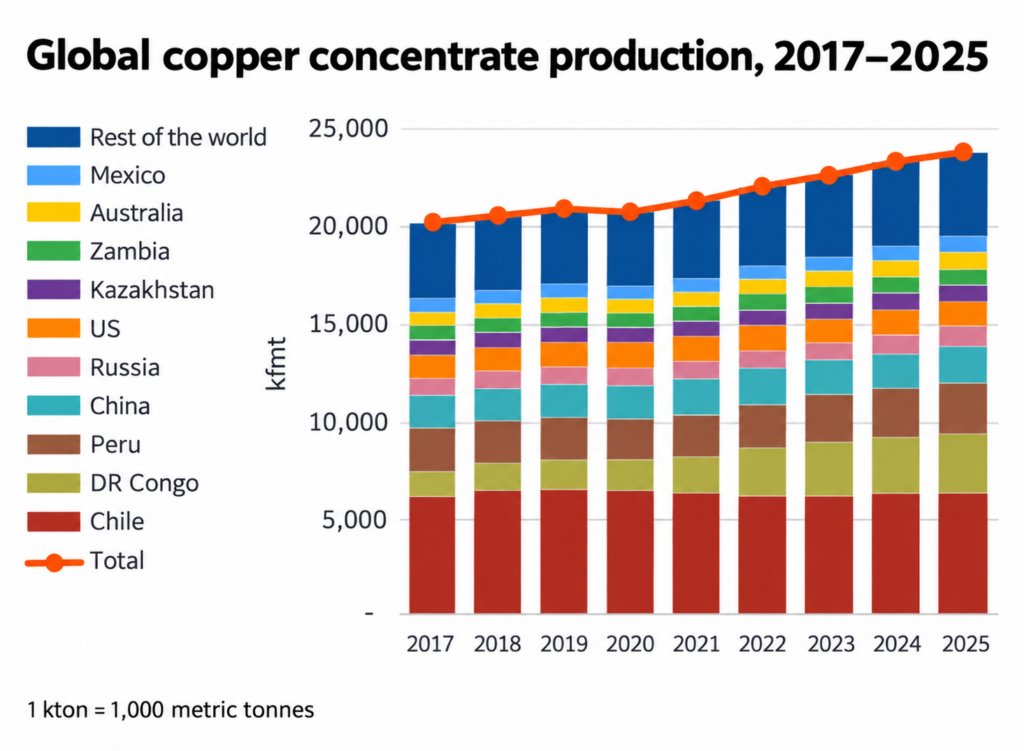
Chile, the world’s largest copper producer, is mining nearly a quarter of global concentrate while smelting just 4.2% of the world’s copper, exposing a widening gap in a supply chain increasingly dominated by China.
The country produced about 23% of global copper concentrate in 2025, yet its share of worldwide smelted copper production has plunged from 13.3% in 1990, according to a study released this week by state copper commission Cochilco. Chile has Latin America’s largest smelting capacity, at an estimated 5.44 million tonnes of concentrate treatment annually, but its plants operate at only about 60% of nominal capacity.
“The immediate opportunity consists of recovering operational continuity, availability and treated volume, before committing new expansions,” Cochilco said in the study.
The imbalance means Chile exports much of its concentrate for processing elsewhere despite dominating global mine supply. About two-thirds of its concentrate exports go to China, giving the country access to the world’s largest smelting market but also exposing it to Chinese demand, industrial policy and commercial conditions.
Processing gap
Cochilco’s call to improve existing operations comes as the economics of global copper smelting deteriorate. New processing capacity and limited concentrate supply have pushed spot treatment and refining charges, or TC/RCs, to around zero or into negative territory.
Those charges are normally an important source of smelter revenue. Their collapse reflects intense competition among processors for available concentrate, weakening the case for adding capacity unless new facilities can operate efficiently and secure reliable feed.
Concentrate supply has been constrained by declining ore grades, project delays and operational disruptions, while demand for copper has risen with the energy transition and new smelters have increased competition for raw material, Cochilco said. Even if concentrate availability improves toward 2028, the custom, or non-integrated, smelting market is expected to remain tight.
Chile currently has five major operating smelters: Codelco’s Caletones, Chuquicamata and Potrerillos facilities, Glencore’s (LON: GLEN) Altonorte and Anglo American’s (LON: AAL) Chagres.
Codelco has an agreement with Glencore to evaluate a new smelting facility, while state-owned ENAMI is advancing plans to modernize its ageing plant. Cochilco, however, cautioned that additional construction needs to clear a high bar.
“The expansion of copper smelting capacity in Chile requires technical, economic, environmental and operational foundations that ensure its viability,” the commission said.
The challenge could intensify as competitors build more processing capacity. Projects under consideration globally could add the equivalent of 8.2 million tonnes of fine copper in annual smelting capacity by 2041, concentrated mainly in Asia, according to Cochilco. That would increase competition for concentrate and put further pressure on treatment charges.
Strategic leverage
Chile’s dependence on overseas processing carries implications beyond smelter economics. Shipping concentrate abroad also transfers more of the downstream processing activity and associated commercial leverage to countries with the capacity to turn mined material into metal.
China is by far the most important destination. While that relationship provides Chilean miners with access to enormous processing capacity, Cochilco said it also leaves the country exposed to decisions made in Beijing over demand, industrial policy and commercial terms.
The immediate problem is therefore not simply whether Chile needs more furnaces, but why the capacity it already possesses is so lightly used. At roughly 60% utilization, improving operational continuity at existing plants could allow the country to process more of its own mine output without first undertaking expensive greenfield construction.
That issue has become more pressing as mine supply faces its own disruptions. Chilean copper shipments fell in August to their lowest level in more than a year after severe winter storms and operational setbacks, according to central bank data.
Copper prices have simultaneously reflected tightening supply conditions. The CME front-month contract reached an all-time high of $6.78 per lb. on Sept. 8 before easing to about $6.70 early Wednesday.
But high copper prices do not resolve Chile’s processing problem. With Asian smelting capacity continuing to expand and concentrate becoming increasingly contested, Cochilco’s study points first to extracting more value from the furnaces Chile already has before adding new ones.
The unanswered question is how much that underutilization costs Chile. Cochilco’s study does not quantify the annual value lost by failing to make full use of existing smelting capacity, nor does it establish whether the government has ruled out building new facilities.
Source: https://www.mining.com/chile-mines-a-quarter-of-worlds-copper-but-smelts-just-4/