



There’s an old saying about “robbing Peter to pay Paul,” which basically has to do with fixing one area at the expense of another.
Right now, Zambia’s critical mineral strategy is walking straight into this trap. The Lobito Corridor is currently the crown jewel of global energy transition projects. Backed by the US, the EU and G7 partners, it is being hyped everywhere. And for good reason, too.
The logic is that this new corridor will bypass old bottleneck routes, slice through the Central African Copperbelt to Angola’s Atlantic coast, and lock down secure copper and cobalt supply lines for the West. It is Washington’s flagship infrastructure response to decades of China’s logistical dominance under the Belt and Road Initiative.
But every monolith casts a massive shadow. By hyper-focusing this multi-billion-dollar transit spine almost entirely on copper, policymakers are completely blind to a quiet giant whose demand is about to explode: manganese.
The battery metal hiding in plain sight
The tendency to think of manganese as simply a steel ingredient is becoming dangerously outdated. It already fortifies aerospace technology, automotive builds and offshore energy equipment. However, its true blockbuster era is happening right now in advanced energy storage. From lithium-manganese battery chemistries to emerging supercapacitor-battery hybrid systems, the metal is becoming increasingly central to the very technologies that prompted the creation of the Lobito Corridor in the first place.
China’s recent commissioning of the world’s first 500 MW/1,000 MWh gigawatt-hour-scale supercapacitor-battery hybrid storage facility is an early glimpse of where the market may be heading. As these technology blueprints scale into massive commercial realities, manganese will no longer be driven by traditional smokestack industries. It will power the energy transition itself, and Zambia sits on an absolute goldmine of it. The question is whether its infrastructure is ready.
A corridor built for one geology
The fundamental flaw is that the Lobito Corridor was drawn to mirror only one type of geology. It neatly strings together the copper-heavy hubs of northwestern Zambia and southern DRC straight to the Port of Lobito. Mines in Solwezi, Kansanshi and Ndola sit comfortably on this luxury transport spine. This copper-centric alignment makes perfect sense since copper is a high-value commodity. Even before refining, it can absorb substantial transport costs while remaining commercially competitive. Every improvement in logistics strengthens an already viable — and politically visible — industry.
But Zambia’s manganese tells a very different geological story. Its principal manganese occurrences lie largely in Luapula Province around Mansa, alongside important deposits in parts of Central Province. These districts sit outside the privileged transport spine that is now attracting international infrastructure finance. The result is an obvious asymmetry that is easy to miss on policy maps but impossible to ignore in mining economics.
Unlike copper, manganese is fundamentally a bulk commodity with a much lower value-to-weight ratio. A mine’s profitability is determined less by the quality of the orebody than by the cost of moving that ore hundreds or thousands of kilometres to market. For copper, logistics creates a competitive advantage, but for manganese, logistics tends to determine whether production remains viable at all.
The bigger opportunity isn’t where most people are looking
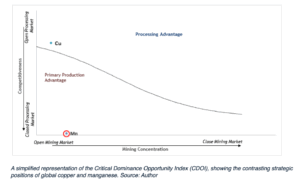
This is where the picture becomes more interesting. The Critical Dominance Opportunity Index (CDOI), a framework developed to identify where countries can realistically build strategic advantage within critical mineral value chains, tells a different story from conventional infrastructure planning.
Copper occupies a favourable position, particularly in Zambia. Global copper processing remains relatively contestable, meaning countries with substantial resources and improving infrastructure can still build competitive downstream industries. The Lobito Corridor reinforces that opportunity by lowering transport costs and strengthening the commercial case for further investment.
Manganese presents the opposite picture. Its global processing market is already highly concentrated, making it exceptionally difficult for new entrants to establish internationally competitive refining industries. I explore this in greater detail in a previously published piece. Yet this is precisely where the opportunity emerges. Because processing has become structurally closed, mining represents the last major point in the value chain where countries can still build strategic advantage.
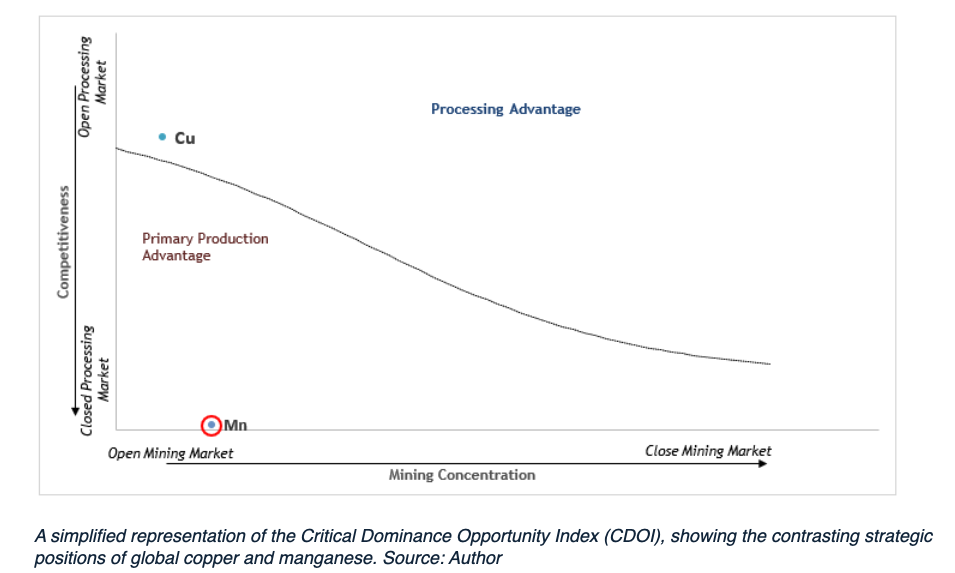
The CDOI captures this contrast clearly. Copper offers opportunities in both production and processing, whereas manganese’s remaining strategic opening lies upstream, where mining remains comparatively contestable even as refining has consolidated. To put it bluntly, while Zambia is unlikely to become a global manganese refining hub, there is an enormous opportunity to become one of the world’s leading manganese producers before the next wave of battery demand reshapes global supply chains.
That changes how Zambia should think about infrastructure. If copper benefits most from processing corridors, manganese benefits most from extraction corridors. That is precisely the distinction current infrastructure planning risks overlooking.
Zambia’s industrial ambitions deserve broader infrastructure
To be clear, none of this means abandoning Lobito, but rather maximizing its strategic logic. Zambia’s own critical minerals strategy emphasizes exploration, local beneficiation and industrial value addition. Those ambitions require more than identifying mineral deposits. They require infrastructure that reflects the country’s full geological diversity rather than reinforcing the dominance of a single commodity.
Upgrading freight capacity around Kapiri Mposhi, extending rail links into manganese-producing districts, improving multimodal integration and planning freight networks around multiple critical minerals rather than a single commodity would strengthen Zambia’s long-term industrial position.
These moves do not take a single cent away from copper; they simply prevent Zambia from becoming a one-trick pony shackled to a single commodity. The irony is that the West’s flagship critical mineral corridor could become significantly stronger by recognizing that Zambia’s comparative advantage extends beyond the Copperbelt itself.
The real strategic lesson
The real risk is not that Zambia is investing too much in copper, but that success in one critical mineral is quietly blinding policymakers to another. Infrastructure is never neutral. The Lobito Corridor shouldn’t be allowed to devolve into a rigid, copper-first echo chamber. If policymakers don’t widen their lens right now, Zambia risks spending billions building the perfect, state-of-the-art railway tailored entirely to yesterday’s priorities.
Nicholas Vafeas is the founder and director of BluMelt Mineral Consulting Limited, an independent consultancy specialising in geological assurance, critical minerals and investment de-risking.
Source: https://www.mining.com/op-ed-the-lobito-blind-spot-and-zambias-manganese-future/