




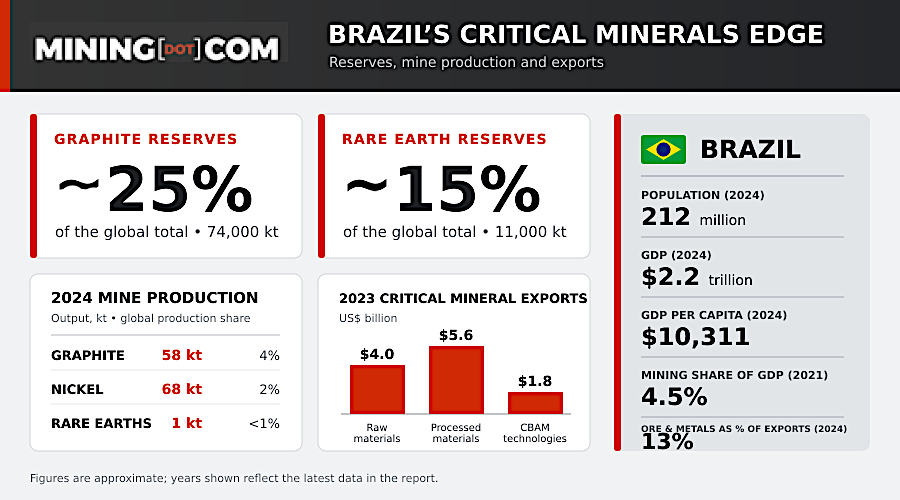
Brazil is courting the foreign capital needed to develop its vast critical mineral resources while pushing to keep more processing and industrial value at home — and moving to give the government new powers to scrutinize who controls strategic mineral assets.
The tension sharpened last week after Brazil’s Senate approved legislation creating a National Policy for Critical and Strategic Minerals. The bill, which now goes to President Luiz Inácio Lula da Silva for final approval, creates a council linked to the presidency that could scrutinize changes in corporate control of companies holding rights to minerals deemed critical or strategic.
The mechanism could also reach significant foreign influence in such companies and international supply agreements that may affect Brazil’s economic or geopolitical security.
It also allows rules tying exports to technical requirements or value-addition commitments and requiring companies to disclose information including destination, final beneficiary and degree of processing.
Exactly which transactions will fall under the rules, and how the screening will work in practice, will depend heavily on regulations to be issued by the government after the law takes effect.
The debate is not theoretical.
US-based USA Rare Earth (Nasdaq: USAR) agreed in April to acquire Serra Verde, Brazil’s only large-scale rare earth producer, for about $2.8 billion. The Pela Ema operation in Goiás state produces all four magnetic rare earths — neodymium, praseodymium, dysprosium and terbium — and the buyer has framed the deal as part of its plan to build an integrated mine-to-magnet supply chain outside China.
The deal has also drawn concern inside Brazil’s government because Serra Verde’s 15-year offtake commits its first-stage output of mixed rare earth carbonate abroad, while Brasília wants the country to develop domestic capacity to separate individual rare earth oxides.
At the time the transaction was agreed, however, the government lacked the specific investment-screening mechanism now contemplated by the critical minerals bill.
“The goal is precisely to transform the country’s mineral potential into economic, technological and industrial development, expanding Brazil’s participation in the higher value-added stages of global chains without giving up its sovereignty,” the Brazilian Ministry of Mines and Energy said in written responses to MINING.COM.
The Brazilian Mining Institute, known as IBRAM, said countries and economic blocs have increasingly approached Brazil as governments seek to secure supplies of critical minerals amid the energy transition and the reshaping of global supply chains.
“We have seen approaches from the United States, European Union, United Kingdom, China and other partners, involving not only mineral supply but also investment, technology and the development of production chains,” IBRAM said in written responses to MINING.COM.
“The challenge now is to create the conditions for this international interest to translate into investment and greater value addition in the country.”
Western supply chain
The geopolitical shift is particularly visible in rare earths, where Western-listed companies are behind several of Brazil’s most closely watched projects under development.
Australian-listed Viridis Mining and Minerals (ASX: VMM) is advancing the Colossus ionic-adsorption clay project in Minas Gerais state, while fellow Australian companies Meteoric Resources (ASX: MEI) and St George Mining (ASX: SGQ) are developing the Caldeira and Araxá projects, respectively.
Developers increasingly present those projects not simply as new sources of rare earths, but as potential suppliers to Western industrial chains seeking alternatives to China, which dominates global processing and magnet production.
“We are facing an international race to develop a more diversified rare earth supply chain that is less dependent on China,” Klaus Petersen, Viridis’ country manager in Brazil, told MINING.COM.
“In this scenario, reaching production in the coming years is fundamental for Brazil to transform its geological advantage into an industrial and commercial advantage.”
Viridis plans to start commercial production of mixed rare earth carbonate, or MREC, from Colossus in 2028. Petersen said a proposed partnership with Belgian chemicals group Solvay could connect Brazilian production with separation capacity and downstream customers, including companies involved in metal and magnet production.
The company is also working with Ionic Rare Earths on a demonstration plant in Poços de Caldas, Minas Gerais, to recycle magnets and produce rare earth oxides, another attempt to build links beyond the mine itself.
Incentives and controls
Brazil’s new critical minerals policy pairs the greater government oversight with incentives intended to bring investment into the sector.
The bill includes a 2-billion-real ($383-million) mineral guarantee fund and a program offering as much as 5 billion reais ($958 million) in tax credits over five years to support processing and transformation projects.
The government has also pointed to tax-incentivized bonds and financing from state development bank BNDES and innovation agency Finep as tools already available for mineral projects.
“For the Brazilian state, the National Policy for Critical and Strategic Minerals will make it possible to establish the guidelines needed to foster research, mining and transformation of critical and strategic minerals in a sustainable way,” lawmaker Zé Silva, who authored the proposal, wrote in its justification.
But the balance between attracting capital and increasing state oversight is likely to be tested as the government writes the regulations that will determine the reach of the new council.
IBRAM said its main demand remains a long-term policy capable of making mineral processing and industrialization competitive in Brazil, with predictable rules, adequate incentives, research and development and a skilled workforce.
“Brazil has all the attributes to advance industrialization associated with critical minerals,” the group said. “But realizing this potential requires predictability, competitiveness and structural actions that allow the country to capture a larger share of the value generated by these chains.”
The debate over how far the state should go has already extended beyond the new policy.
Separate proposals in Congress this year sought to create a state-controlled company known as Terrabras to operate in rare earths and other critical minerals, drawing criticism from IBRAM, which argued the government should focus on regulation and creating investment conditions rather than competing directly with private miners.
The legislation approved by Congress stops short of creating such a company. Instead, it gives the government a potentially powerful role in determining which projects receive support and in scrutinizing sensitive transactions involving strategic mineral assets.
Foreign miners, governments and industrial groups are already positioning themselves around Brazil’s deposits.
The next test is whether Brasília can use that interest to accelerate investment without deterring the capital it needs, while ensuring that more of the processing, technology and industrial value remains in Brazil.
* Gabriel Garcia is a journalist at CNN Brazil, based in Brasília, covering mining, infrastructure and economic policy. He specializes in critical minerals, mining regulation and the geopolitics of global supply chains.
Latin America has been at the centre of a growing global power struggle this year, as governments and investors focus on who controls critical minerals and the supply chains behind them.
If the region matters to you, don’t miss MINING.COM’s regional series tracking the geopolitical forces reshaping it and why markets are increasingly driven by global alliances as much as local politics.
Other countries in the series:
Source: https://www.mining.com/brazil-targets-bigger-role-in-critical-minerals-rush/