




South America is moving to turn its vast mineral wealth into a coordinated production and investment hub as governments race to secure critical minerals for energy, technology and defence.
Chile, Argentina, Bolivia and Peru signed a joint declaration on strategic minerals on Aug. 28, establishing a regional framework to promote responsible mining investment, technical cooperation and deeper integration across mineral supply chains.
The agreement was reached during the first ministerial meeting on strategic minerals in Chile’s capital Santiago, attended by mining authorities from all four countries.
The governments said the initiative is intended to position the region as a reliable strategic supplier of minerals needed for decarbonization, electromobility and artificial intelligence.
“Argentina, Bolivia, Chile and Peru’s pact on geology, regulation, suppliers, skills and finance could turn multiple markets into a more coherent investment proposition — but only if governments sustain coordination,” Mariano Machado, Americas principal analyst at risk intelligence company Verisk Maplecroft, said in a note on Friday.
Supply squeeze
The alliance comes as demand for critical minerals rises while production remains concentrated and new supply is slow to develop.
Based on the current project pipeline, the International Energy Agency projects global copper supply could fall 25% short of demand by 2035, with new mines typically taking more than 15 years to reach production.
Lithium faces similar pressures, compounded by stagnant greenfield exploration spending and rising discovery costs.
Latin America is well placed to help fill that need, according to a recent World Economic Forum report produced in collaboration with McKinsey & Co.
The region holds significant reserves of copper, lithium, nickel, graphite, manganese, rare earth elements and other minerals essential to electrification, the energy transition and digital infrastructure.
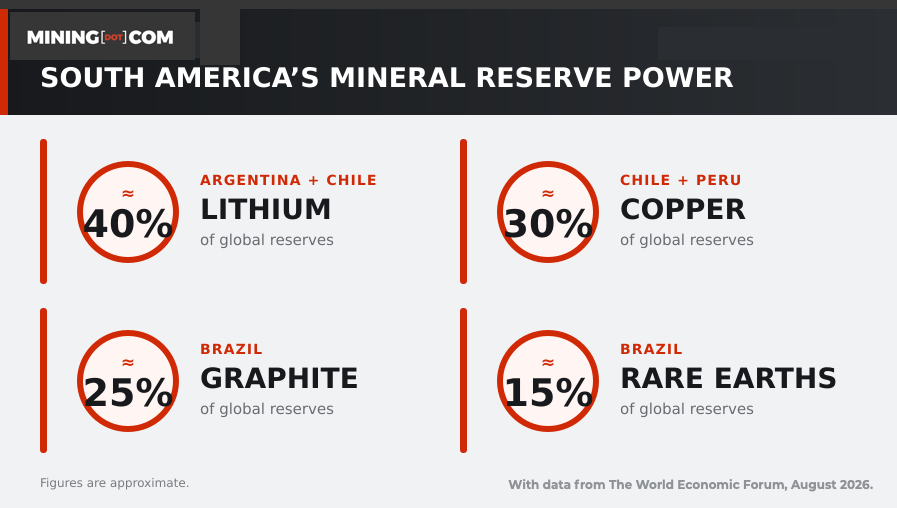
Argentina and Chile together account for about 40% of global lithium reserves, while Chile and Peru hold roughly 30% of the world’s copper reserves. Brazil has about a quarter of global graphite reserves and 15% of rare earth reserves, according to the report.
The WEF said Latin America’s competitive advantage extends beyond the scale of its deposits to the complementary resources and industrial capabilities spread across its economies. At the same time, Western efforts to reduce exposure to China are directing mining investors towards new markets, putting the region near the front of the queue, Machado said.
The new declaration seeks to capitalize on those advantages by coordinating policy in areas including geology, regulation, suppliers, skills and financing.
One treaty, $20.7 billion
Chile and Argentina are already putting that approach into practice. The countries have cleared operating protocols for major cross-border projects, reducing uncertainty where mineral deposits cross an international boundary but encounter separate permitting and operating regimes.
Clearer rules could make such projects easier to plan and finance. Still, unions, communities and provincial governments are likely to push to retain jobs, investment and revenue on their side of the border.
According to Chilean mining and economy minister Daniel Mas, reviving the mining integration treaty with Argentina would unlock more than $20.7 billion in investment and add 540,000 metric tons of copper a year to the market.
The larger challenge is turning South America’s geological strength into the industrial capacity needed to capture more value from its resources rather than simply exporting mined material.
Brazil’s newly approved critical-minerals framework illustrates that ambition. It pairs roughly $1 billion in tax incentives and a new guarantee fund with a drive to expand domestic refining and production of batteries and magnets.
The support comes with tighter government oversight. A new council will be able to scrutinize foreign partnerships, ownership changes and mining titles, creating a trade-off between incentives for downstream development and greater state control over investment.
Verisk Maplecroft’s country-risk data identifies Argentina, Brazil, Chile and Peru as attractive critical-minerals markets because they combine large deposits with relatively lower resource-nationalism risks and improving operating environments.
But geological potential and regional agreements alone will not unlock the capital needed to develop them. Permitting, fiscal stability and policy continuity will determine whether South America can convert its mineral power play into new mines, processing capacity and a lasting place in global supply chains.
South America has the resources to wield greater influence over critical-minerals supply. The harder task is creating the investment conditions to turn them into production.
Latin America has been at the centre of a growing global power struggle this year, as governments and investors focus on who controls critical minerals and the supply chains behind them.
If the region matters to you, don’t miss MINING.COM’s regional series tracking the geopolitical forces reshaping it and why markets are increasingly driven by global alliances as much as local politics.
Other countries in the series:
Source: https://www.mining.com/new-deals-sharpen-south-americas-critical-minerals-edge/